The research group at Nanjing University has achieved interface superconductivity in LaFeO3/SrTiO3
Recently, Professor Yuefeng Nie's research group from the College of Engineering and Applied Sciences at Nanjing University successfully observed two-dimensional superconductivity at the LaFeO3/SrTiO3 interface using oxide molecular beam epitaxy (OMBE) to fabricate high-quality oxide epitaxial films. This discovery provides a new material system for exploring the rich quantum effects at oxide interfaces. The related findings were published in Nano Letters under the title A Two-Dimensional Superconducting Electron Gas at LaFeO3/SrTiO3 Interfaces (DOI: 10.1021/acs.nanolett.4c05774).
In transition metal oxide interfaces, novel physical phenomena can emerge that are fundamentally different from those observed in the bulk materials. Examples include two-dimensional superconducting electron gases, ferromagnetism, and the coexistence of superconductivity and ferromagnetism at the LaAlO3/SrTiO3 interface. However, the mechanisms and nature of the coexistence of superconductivity and ferromagnetism at these interfaces remain subjects for further investigation.
In this study, the research group observed interface superconductivity at the LaFeO3/SrTiO3 heterostructure, with a superconducting transition temperature (Tc) of 333 mK. The Berezinskii-Kosterlitz-Thouless (BKT) phase transition at low temperatures indicates the two-dimensional nature of the superconductivity. By applying a back gate voltage (Vg) on the SrTiO3 substrate, a dome-shaped Tc-Vg dependence of the interface superconducting transition temperature was observed. Additionally, magnetoresistance hysteresis behavior was observed within the superconducting temperature range. However, in contrast to the reports for LaAlO3/SrTiO3, no clear ferromagnetic signals were observed in LaFeO3/SrTiO3, providing new experimental insights for understanding the mechanism behind this magnetoresistance hysteresis.
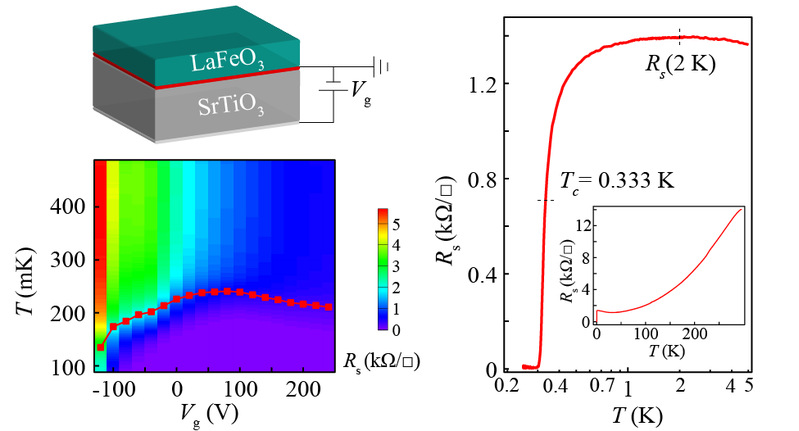
Figure 1 Two-Dimensional Superconductivity at the LaFeO3/SrTiO3 Interface and Its Back-Gate Control
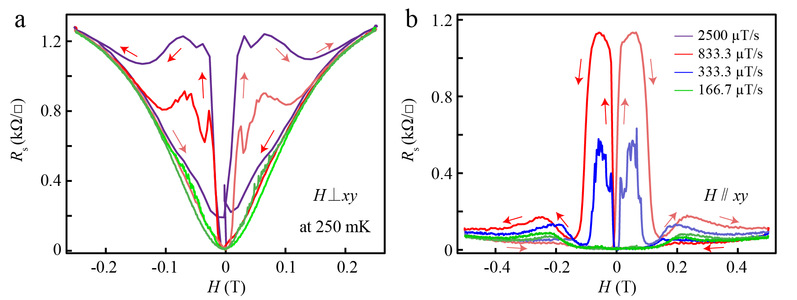
Figure 2 Magnetoresistance Hysteresis Behavior in LaFeO3/SrTiO3
Zhangwen Mao, a Ph.D. student from the College of Engineering and Applied Sciences Nanjing University, and Dawei Qiu, a Ph.D. student from the University of Science and Technology of China, are the co-first authors of this work. Prof. Yuefeng Nie and Prof. Guanglei Cheng are the corresponding authors of the paper. Prof. Ye Zhu from The Hong Kong Polytechnic University provided electron microscopy support for this work. The research was funded by the National Key R&D Program of China, the National Natural Science Foundation of China,and other projects.