Recently, combining molecular beam epitaxy and atomic-hydrogen topotactic reduction, we successfully synthesized superconductinginfinite-layer nickelate thin films with atomically flat surfaces under ultra-high vacuum (UHV) conditions. This achievement paves the way for further investigation of the electronic structure as well as revealing the superconducting mechanism of this new unconventional superconductor.
Since its initial discovery in 2019, superconducting infinite-layer nickelates have attracted wide attention due to their lattice and electronic structure similarities to high-Tc cuprates. They provide important new opportunities for understanding the unconventional high-temperature superconducting mechanisms. Experimentally, superconducting infinite-layer nickelates are typically synthesized by reducing the precursor perovskite phases (RNiO3) using reducing agents, such as CaH2. However, the film surfaces are prone to damage during the reduction process, which fails to meet the requirements for electronic structural characterizations, such as angle-resolved photoemission spectroscopy. Therefore, there is currently no breakthrough in achieving the momentum-resolved band structures and superconducting gap symmetry, posing a significant challenge in understanding the superconducting pairing mechanism in infinite-layer nickelates.
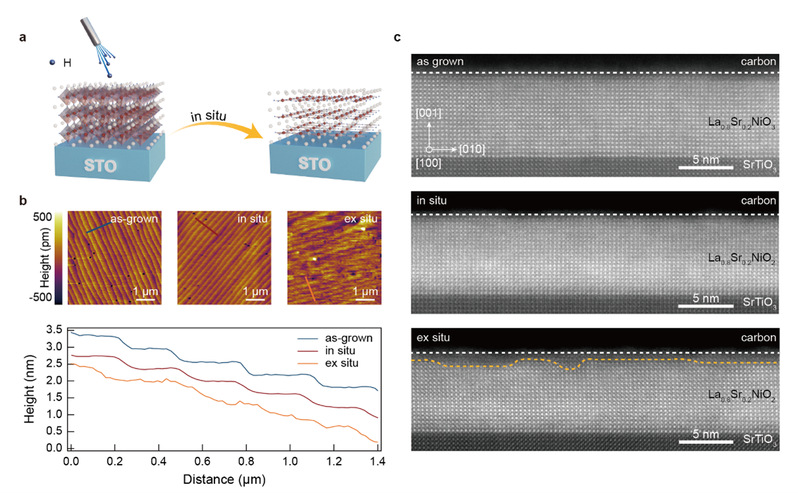
Figure 1 (a) Schematic of in situ synthesis of infinite-layer nickelate thin films; (b-c) Surface morphology and cross-sectional transmission electron microscopy characterization of La0.8Sr0.2NiO2 thin films, showing the atomically flat and clean surfaces for in situ reduced samples.
In this work, the UHV-compatible atomic hydrogen is applied as the reducing agent after modifying the atomic hydrogen source and constructing a high-vacuum reduction chamber. With systematic optimization of reduction parameters, high-quality La0.8Sr0.2NiO2 superconducting thin films were in situ synthesized. As shown in Figure 1, in contrast to the ex situ reduced film, the in situ reduced one retains the atomically flat surface of the precursor perovskite phase, providing high-quality samples for subsequent electronic structural characterization. Based on this significant progress, the research team achieved a breakthrough in momentum-resolved electronic structural characterization of superconducting infinite-layer nickelates (arXiv:2403.07344). Furthermore, this UHV-compatible reduction method can be applied to the fabrication of other novel oxide thin films with infinite-layer structures, as well as to the precise control of oxygen content and carrier concentration in oxides, enabling in situ characterization and manipulation of novel correlated quantum phases.
The related findings titled In Situ Preparation of Superconducting Infinite-Layer Nickelate Thin Films with Atomically Flat Surface have been published in Advanced Materials (https://doi.org/10.1002/adma.202401342). PhD student Wenjie Sun and Zhichao Wang are the co-first authors, and Prof. Yuefeng Nie is the corresponding author. PhD student Bo Hao, Shengjun Yan, and Dr. Haoying Sun have made important contributions to this research. This work has also received strong support and assistance from Prof. Yu Deng and Prof. Zhengbin Gu from Nanjing University. This work was supported by the National Key R&D Program of China, and the National Natural Science Foundation of China.