Recently, a collaborative research team led by Prof. Yuefeng Nie from College of Engineering and Applied Sciences and Prof. Xuefeng Wang from School of Electronic Science and Engineering in Nanjing University revealed the upper critical field anisotropy in nickelates by preparing high quality nickelate films (La0.8Sr0.2NiO2) and performing systematic magnetotransport measurements. This upper critical field anisotropy provides new experimental results for understanding the mechanism of superconductivity in nickelates.
Since the discovery of cuprate high-temperature superconductors in 1986, the mechanism of unconventional high-temperature superconductivity (HTSC) has been at the forefront in condensed matter physics. As a new class of unconventional HTCS system, infinite-layer nickelates have quasi-two-dimensional layered crystal structure and 3d9 electronic configuration similar to that of cuprates, providing a new platform for the study of HTSC mechanisms. Theoretical and experimental studies have shown that there are also obvious differences between these two types of superconducting systems, for example, there are multiband features in nickelates, which are inconsistent with the widely accepted single-band picture in cuprates. Thus, it is particularly important to study the connection and difference between these two systems to reveal the mechanism of HTSC. For superconductors, the upper critical field (Hc2) can provide valuable information about the dimensionality of superconducting states and the pair breaking mechanisms of Cooper pairs. In previous study, it was found that the Hc2 of the Nd1-xSrxNiO2 system exhibits isotropic Pauli-limited character, which is significantly different from the anisotropic transport properties dominated by the single-band model in cuprates, posing a new challenge for understanding the mechanism of HTSC.
In this work, using the oxide molecular beam epitaxy (OMBE), high-quality precursor La0.8Sr0.2NiO3 films were synthesized by systematic optimization of growth parameters. And the infinite layer La0.8Sr0.2NiO2 superconducting thin films were further obtained by topotactic reductions of precursor La0.8Sr0.2NiO3 films. As shown in Figs. 1a-1d, the scanning transmission electron microscopy results show that there are no observable extended defects in the optimized films which are commonly observed in previous studies. And a significant increase in the superconducting transition temperature (Tc,onset = 18.8 K, Tc,zero = 16.5 K) is also realized, providing a basis for exploring the intrinsic properties of superconducting nickelates. Further magnetotransport measurements shows that the upper critical fields are anisotropic in La-based nickelates and violate the estimated BCS Pauli limit for in-plane magnetic fields (as shown in Fig. 1e). Moreover, the anisotropic superconductivity has been further manifested by the cusp-like peak of the angle-dependent Tc and the vortex motion anisotropy under external magnetic fields. The present work shows the anisotropic magnetotransport properties in La-based infinite layer nickelates as that in cuprates, which provides a new experimental basis for comparing the similarities and differences between nickelates and cuprates to reveal the mechanism of HTSC.
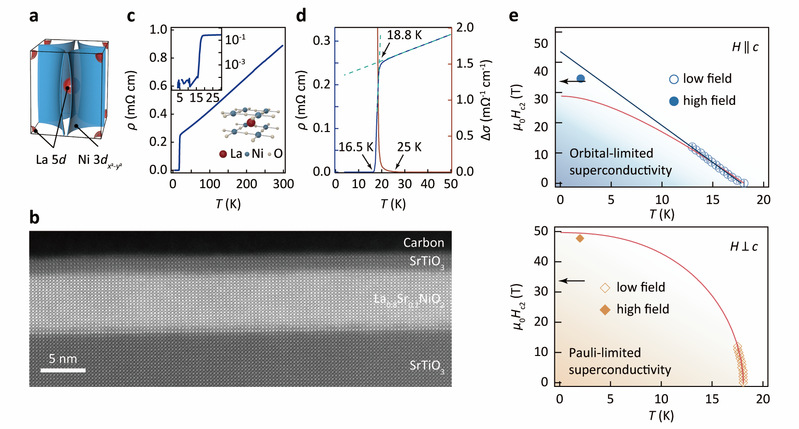
Figure 1 (a) Schematic drawing of the Fermi surface of infinite-layer nickelates. (b) scanning transmission electron microscopy image of La0.8Sr0.2NiO2 thin film, demonstrating high crystalline quality. (c) Temperature-dependent resistivity of La0.8Sr0.2NiO2. (d) Enlarged view of (c), and the characteristic temperatures of superconducting transition are marked by black arrows. (e) Temperature-dependent upper critical field for magnetic fields along c axis and in the a-b plane.
The relevant work has been published in Advanced Materials entitled Evidence for anisotropic superconductivity beyond Pauli limit in infinite-layer lanthanum nickelates (https://doi.org/10.1002/adma.202303400). Wenjie Sun, Yueying Li and Ruxin Liu are the co-first authors of this work. Prof. Yuefeng Nie and Prof. Xuefeng Wang are the co-corresponding authors of the paper. Jiangfeng Yang, Jiayi Li, and Wei Wei are key collaborators in the study. This work is also supported and assisted by Prof. Yu Deng from Nanjing University, Prof. Yue Sun and Prof. Zhixiang Shi from Southeast University, and Gangjian Jin and Prof. Zengwei Zhu from Huazhong University of Science and Technology. This work is supported by fundings including the National Key R&D Program of China, the National Natural Science Foundation of China, and the “Chang Jiang Scholars Program” of the Ministry of Education. In addition, the National Laboratory of Solid State Microstructures of Nanjing University, the Collaborative Innovation Center of Advanced Microstructures and Jiangsu Key Laboratory of Artificial Functional Materials also provide important support for this research.